


Disclosure: I currently receive research support from the National Institute on Aging, and I was awarded an API credit grant from Anthropic through their AI for Science program. Views expressed in this essay do not reflect the views of my employer or funders.
Both of my grandparents spent most of their years after 50 in the United States because of their healthcare needs. The US better served them compared to their homeland of Jamaica because they had better access to comprehensive healthcare. They also had something many patients interacting with our broken healthcare system never will: my loving mother. She is a brilliant doctor who can answer any medical question, hedges her uncertainty with clear reasoning, explains disease prognosis in plain language, and drops whatever she was doing to be their care advocate. She was their medical LLM before medical LLMs existed. Despite having a live in the flesh medical LLM, my mother’s expertise and care orchestration were not enough to keep my grandparents healthy. When resources were not readily available to my grandparents, when the system around them contracted, and when payment was an obstacle, having the right information and a brilliant advocate did not close the gap in their healthcare needs. My grandparents’ most pressing needs revolved around access, cost, and whether anyone with power over the healthcare infrastructure cared enough to maintain it.
I have faith in the power of medical AI1 to improve these gaps along the margins, specifically computational healthcare research that can lead to more drug possibilities and maybe even help patients navigate options for receiving care. I also believe medical AI can close information gaps and assist in clinical care. System level change comes from the hard work of governance, coalition building, trust building, and listening. Short term, I struggle to see a world in which AI companies do what is needed to systemically improve our healthcare industry because I have not seen big tech companies execute this well with other technologies. For example, electronic health records, wearable devices, and more have provided more information to patients. Information is beneficial but not the same as access. Long-term the systemic barriers I am describing will force AI companies to take firmer stances on healthcare policy. If they do not they will become another institution that promises more than our system can deliver. AI is a transformative technology that has the possibility to make progress in curing disease, but that progress will be constrained by access and cost.
Over the last two years of my research career, I watched the conversation about AI in healthcare accelerate from cautious optimism to claims with near-certainty that these tools will positively transform medicine.2,3 I am genuinely impressed by many AI tools,4 and it is clear to me how we could see immense progress in tasks that rely on computation speed and scale, but these gains are still difficult to transfer to the people who need healthcare.5 Take a recent paper in Nature led by Ziad Obermeyer. His team analyzed ~450,000 ECGs (a way to measure signals made by your heart) and used a deep learning method to find a novel biomarker for risk of sudden cardiac death. This is especially impressive because it is additive to our existing healthcare practices. People that are currently missed even when they are ingrained in the system would not have been identified without this method, which presents a clear case of AI screening improving care. I am even optimistic about prospects of getting people affordable access to ECG readings. Again though, better understanding of risk does not funnel people into receiving the care they need. Up to this point I have not addressed the issue of bias in medical AI, which is a pressing topic that others are working to address. Biased or not, these tools might deliver information into a system that fails to get a patient the care they need.
When I look at the trajectory that the intersection of AI and medicine is heading, the more I see the same gap my grandparents lived inside. Resource allocation sits at the foundation of medicine. I believe AI is on a trajectory of improving the organization and orchestration of clinical information, but it has not proven it is ready to meaningfully improve how resources are allocated. Even if it is not AI companies’ job to distribute wealth or think about this,6 the ability for people to live meaningful lives and get resources will underlie the ability for AI companies to improve health.
As a rising 4th year Ph.D. candidate at Duke in 2024, I applied for a travel scholarship to attend the first Responsible AI for Health Symposium (RAIHS) at Johns Hopkins (my current employer as a postdoctoral fellow). That meeting was super fun. Summer 2024 was a point when ChatGPT has recently busted onto the scene and was a tool that the public was fairly benevolent about (the frontier models at the time were GPT-4o, Claude 3 Opus, and Gemini 1.5 Pro). People were using it to debug code, figure out what ingredients you could replace in a recipe, maybe even incorrectly count the number of Rs in strawberries. There was urgency in the room at RAIHS. Many were cautiously optimistic given the meeting was focused on safety. We all were thinking about putting patients first and how we can learn from the past mistakes of medicine to make better tools for patients today.
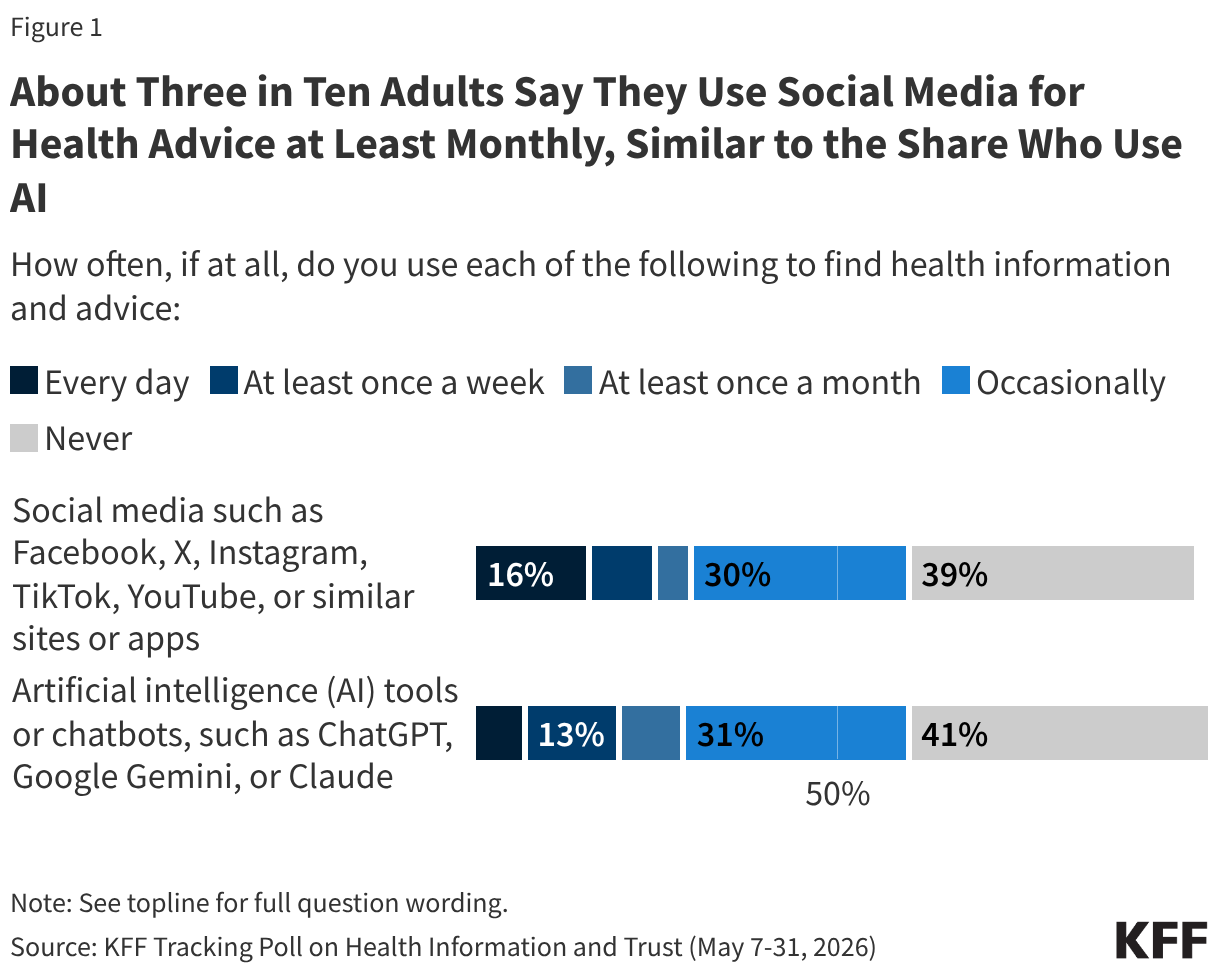
Today, while the AI tools are increasing their benchmarked capabilities exponentially, I am more worried than ever about how we are deciding to deploy these tools in healthcare. While health systems have a lot to gain from AI, I worry about overwhelming amounts of new information that do not actually improve health outcomes. Surveys estimate that upwards of 30% of consumers use AI for their perceived medical needs. When I talk to doctors about this phenomenon, they are relatively torn. Some anecdotes show how ChatGPT Health can be helpful for basic clinical advice when framed with sound reasoning and clear communication. Of course, not everyone speaks like a doctor or is a reliable narrator for how what is happening to their body might translate to the most pressing clinical decisions. In my own research in a forthcoming project, my team is looking at how phrasing questions like a patient v. like a doctor can yield different answers from consumer AI products. I have been pleasantly surprised by the resiliency of the advice provided. Even in examples where the (allegedly not medical) advice is problematic, I am optimistic about our ability to tune tools and change the underlying bias that is difficult to remove from the real world. My largest concern is that as these tools get better at the tasks that we need in medicine, we have not worked actively to eliminate the bottlenecks that prevent people from getting quality healthcare.
My research centers on the “most vulnerable” communities. These communities getting quality medical information they can act on should be celebrated. Especially when the alternative might be an algorithm-based social media influencer trying to sell an experimental peptide or a compounded GLP-1 that is hard to source with unclear safety and efficacy data. AI can provide both poor and good medical information. When information that sounds like expertise is readily available (through social media, AI, and the crossover of both) we move to a more “every man for themselves” healthcare system. At the same time healthcare access is shrinking through Medicaid cuts just at the moment where people have even more questions and information to navigate.7 There are many AI chatbots available for consumers to ask hundreds of medical questions, sometimes the description of a situation is accurate and sometimes it is inaccurate. A patient can easily latch onto quality advice provided for an inaccurately described situation, or they can miss something important about their current condition. Primary care doctors and other generalists are often the gatekeepers of advancing to more specialized care. They are also some of the worst paid doctors, and in many communities serve as a catch-all for a ton of complicated needs. Investment in the support of these heroes alongside AI would make sense to me, but this only happens through insurance and healthcare reform.
I am comfortable with companies that have a stated goal of getting more profit, but I think this motivation needs to be met with realism about how that goal layers onto our current American healthcare system. A system that is increasingly viewed as more extractive and has a healthcare policy landscape leaving more people to fend for themselves. Profit-seeking companies will find their goal of return on investment a priority over the return on their promises for better health. To achieve their duty of returning value to shareholders: AI companies have to put up with a reality where they either save systems money, save patients money, or make clinical care better. I think that saving systems money can be done but I am skeptical that means better care for patients. I think patients could save money but worry about what they might miss that a doctor would have caught early. Finally, the best prospect for these companies is making care better but these improvements are in terms of delivery of care instead of systemic change. What do we do for people who are dealing with serious issues who cannot get what they need but have clinically sound guidance from AI?
Earlier this year, we had our 2nd Responsible AI for Health Symposium at Hopkins. The breadth of attendees was even larger but the mood in the small group discussions was more somber than the first meeting in 2024. Superstar physician Atul Gawande was one of the keynote speakers, alongside David Rhu the Global Chief Medical Officer at Microsoft. The conversations of the here and the now in AI and healthcare were a lot more pressing than in 2024 but there was surprisingly little conviction on navigating this landscape with clear regulation and safeguards. For as much optimism and hope I had in 2024 when the tools were still in their “not knowing the number of rs in strawberry” era, the pace of model improvement has not paced with AI regulation in 2026. While regulators plan for the industry’s future, we are in a moment in which companies are writing their own self-serving plans8 (whether it be pro open-source, pro pacing the frontier, pro selling chips to whoever buys them, pro selling compute to whoever buys it). Some pieces of all these plans are important and could lead to meaningful regulation but the government is currently playing catch up.
While there are promises of medical AI to deliver positive returns on human life, other domains this technology touches are showing how its presence holds many downsides. xAI’s chatbot “Grok” that is integrated into X/Twitter went off the rails and started undressing women and children on the app. There are many other signals in 2026 for how AI companies affect society (e.g. Anthropic’s Mythos model being pulled from the market for security concerns, and OpenAI’s models hacking the company HuggingFace while OpenAI underwent safety testing). This is all with the background of an AI data center backlash that is one of the few bi-partisan issues of the past few years ( Jasmine Sun did a great feature story on this here). In his book A Giant Leap Robert Wachter talks about how healthcare will inevitably have its “Cruise Moment” (an autonomous car company had a newsworthy moment where a human driven car hit a pedestrian and a nearby autonomous vehicle dragged that pedestrian). This was a PR disaster for Cruise and led to them halting their services. Regulators are paying increased attention to the high-profile moments when AI labs appear to not have control of their creations. Sloppy errors in medicine could create a high-profile mishap (or even cascade of them) in ways that impact the public’s health. The same public who already are uneasy about the future of AI.
In healthcare we judge people by improved health outcomes. We know about United States healthcare being troubled. Hypothetically curing disease is not the same as providing services for people who desperately need them. Orchestrating care and making recommendations to people who are losing access will also create a frustrating circumstance. People already do not like AI companies because they see the companies building infrastructure in their neighborhoods, they feel the cost of electricity rising, the technology has allowed people to overwhelm every corner of the internet that is based in text generation, it makes it easier for their loved ones to fall victim to scams, and many of the prominent figures mention how it might cause wide scale job disruption. How are people going to have all their diseases cured if the administration that many of the prominent AI companies monetarily support is cutting back on healthcare access, and hypothesized job displacement could push people from stable jobs?
Patients could plausibly get great clinical information from AI, get better treatment from a physician using new AI tools, but then their lack of access and resources could prevent them from managing their healthcare needs. This is the dilemma people in my family faced when they had the loving support of my mother who could explain their disease prognosis, carefully explain to them what they could do, and be their care advocate, yet did not have the resources to seek care. These are people who are still failed by the system even with new cures that might come someday. System building will be the hardest step of the improvement in healthcare AI companies need. They need to learn lessons from those of us who hear about people who had great information and doctors who cared, but still lacked the resources to execute.
1 I center this essay on “AI” but present evidence of a novel deep-learning evaluation, talk about coding harnesses, clinical decision support tools with AI integrations, and more. This is not the most precise way to talk about all of these tools but helps for readability.
2 In Dario Amodei’s (CEO of Anthropic) 2024 essay Machines of Loving Grace he wrote: “my basic prediction is that AI-enabled biology and medicine will allow us to compress the progress that human biologists would have achieved over the next 50-100 years into 5-10 years. I’ll refer to this as the “compressed 21st century”: the idea that after powerful AI is developed, we will in a few years make all the progress in biology and medicine that we would have made in the whole 21st century.”
In the same article prior to this assertion, he stated: “it is worth pointing out explicitly that in some ways biomedical innovations have an unusually strong track record of being successfully deployed, in contrast to some other […] many technologies are hampered by societal factors despite working well technically. This might suggest a pessimistic perspective on what AI can accomplish.”
Which is in line with my argument and I think a key underestimate which cannot be brushed off.
One of Dario’s former mentees Emma Pierson, a computer science professor at UC Berkeley wrote in the Atlantic about her concerns on the current pace of AI progress in relation to possible health benefits stating: “So as daunting as a cure for cancer remains, I am certain that AI will contribute to it. And if curing cancer were the only result of building ever more powerful AI systems, I would cheer for their arrival. But the problem is that their impacts are much broader, and we are moving too quickly to ensure that these impacts are positive”
3 In a 2025 essay Abundant Intelligence Sam Altman (CEO of OpenAI) wrote “If AI stays on the trajectory that we think it will, then amazing things will be possible. Maybe with 10 gigawatts of compute, AI can figure out how to cure cancer.”
Yesterday, OpenAI’s chief economist Ronnie Chatterji and labor economist Alex Martin Richmond published an essay in The Economics of AI arguing that even in a “post-AGI economy”, market forces will not distribute care to those who need it most, and that institutional redesign will still be needed.
4 While the initial roll-out of chatbots was a fun party trick and only really led to me seeing value every few weeks, I switched over to a true believer when the harness layers like Claude Code and Codex released. Like many, my first Claude Code project was changing my personal website.
5 Adam Kucharski outlined this in his essay What happens when scale comes for science, which I think is very illustrative of how some tasks in AI are remarkable for AI assistance while others are not.
6 To their credit the frontier AI labs have teams that are attempting to tackle society-facing issues (e.g. OpenAI Foundation, Societal Impacts team at Anthropic, and the Anthropic Institute under Jack Clark )
7 For this essay I am referring to the direct economic and access impacts of Medicaid cuts through HR.1, but I think that this could also be extrapolated to downstream effects of Medicaid work requirements as well as if there are job losses due to AI. In my mind these issues would compound.
8 Jensen Huang, CEO of NVIDIA in July 2026 wrote a letter claiming the importance of Open Weight models for American leadership (with co-signs from Microsoft and Open AI). Marc Zuckerberg, CEO of Meta wrote his own version of this type of document.