


Disclaimer – This essay was co-written by Michael D. Green and Elizabeth Ginexi. Where it denotes “MDG” they are Michael’s words and thoughts, and where it is “EG” they are Elizabeth’s. Where it is “MDG + EG” it is an equal contribution. We both contributed to the editing of each other’s work.
MDG: The National Institutes of Health has immense power to foster scientific discovery and improve the health of our nation. That power should be wielded carefully. Right now, it is being used to harm early career scientists and popular media outlets have not fully grasped the severity of the situation. The raw dollar magnitude of the disruption is clearly hitting established scientists hardest, because they hold the largest grants. Lead investigators have established bodies of work and developed skills to weather the storm, whereas early career scientists carry the most vulnerability. The senior scientists who run labs are the ones who hire research associates, PhD students, and postdoctoral fellows. Alarmingly, the opportunities that propelled established scientists’ careers are either heavily contracting or no longer exist. The average American will not feel this harm for decades, but the stories of stalled careers are everywhere today. This essay is a data dive into 5 NIH programs that collectively spend around $500 million annually to support PhD students, postdoctoral fellows, and promising researchers at the beginning of their careers. Collectively these 5 programs support around 5,000 individuals each year, but that number is dropping fast. Targeted political action to shrink the federal workforce and the number of scientists we produce in this country has put early-career researchers, the people who should be most hopeful about the future, in a dire position.
“We are leaving discoveries on the table... Those discoveries are the ones that in 10, 20 years will contribute to economic growth, improved health, human longevity. That’s what we are choking off.” — Donna Ginther, Economist, (The Guardian)
Present Day Problem
MDG + EG: The NIH and the infrastructure it built to support early career scientists is crumbling. New awards have slowed to a trickle. Universities organized their student admissions, faculty hiring, promotion, and tenure systems around a steady flow of extramural funding. That assumption no longer holds. The institutes in the NIH themselves are operating under conditions that program officers and applicants alike have not seen in their careers.
The NIH has historically supported the biomedical workforce through a sequence of award mechanisms tied to career stage. PhD students and postdocs are supported by individual fellowships (the F-series) and institutional training grants (the T-series), which cover stipend, tuition, and mentored research time. The DP5 “Early Independence Award” lets exceptional early-career scientists skip the postdoc and move into an independent role immediately. Career development awards (the K-series) bridge the mentored training years and full research independence, giving faculty protected research time as they build their own body of research. These programs are worth reforming. Instead, the current administration is allocating the same overall award amount to dramatically fewer investigators, and the scholars who do receive awards cannot pre-spend the multi-year obligation.
From a May 14, 2026 news article in Nature: “The situation at the National Institute of Mental Health (NIMH) seems particularly acute. In a meeting back in March, institute staff members were told that the ‘NIMH typically funds between 900 and 1,000 new awards yearly, and at current staffing levels, NIMH will be able to fund 50 for the entire [institute] for the entire fiscal year’, according to notes that Nature obtained.”
EG: The staffing shortage inside the NIH, and particularly inside NIMH, is at a crisis level right now due to the 2025 mass reduction in force (RIFs) and voluntary separations. NIH grant awards are issued by the grants specialists who are highly trained experts in the policy and legal aspects of award issuance. There are simply not enough of these skilled staff left to do the work. At NIMH and other institutes, leadership has attempted to detail other staff to help; however, this is not a viable solution. It is simply not possible to provide a crash course in grant award policy and procedures. Also, these are strict legal documents. Signing off on grant awards requires specific authorities that only the grants specialists hold. You cannot swap people into the job randomly to get this work done. Fewer awards will be issued this fiscal year due to these staffing shortages, and it is very likely that large sums of money appropriated by Congress will be unspent by October 1, 2026 (the end of the fiscal year).
Data Dive
MDG: To understand this issue, we must understand how we execute biomedical research in the United States. When research faculty are hired into the tenure-track positions, universities often provide a “start-up” package to launch their work. After that initial sum of money, faculty are expected to support their research on their own through extramural grants like the ones the NIH offers. A 2019 analysis demonstrated that researchers who previously held a training award had higher odds of later receiving an R01, the 5-year award that is a staple of the NIH portfolio and a near-universal expectation for promotion and tenure at medical research universities. There are also positions entirely supported by extramural grant funding; those individuals face particular pressure given the current chaos at NIH.
The current NIH Director’s own research shows that supporting young scientists matters because early-career researchers are disproportionately creative. Research-centered departments have built their promotion and tenure processes around extramural funding, and many are now paying the price for that choice through hiring freezes and delayed tenure reviews. Senior faculty have benefited from a system built around grant funding; data shows these opportunities are shrinking.
On May 22nd, 2026 I used the NIH RePORTER API to retrieve data on the programs predoctoral scholars (PhD students) and postdoctoral fellows (researchers immediately after their PhD) can apply for. The dataset for this analysis is available here. I selected 5 programs early career scientists can apply for: the NIH Predoctoral Individual National Research Service Award (F31), Postdoctoral Individual National Research Service Award (F32), Predoctoral to Postdoctoral Fellow Transition Award (F99), Career Transition Award (K99), and Early Independence Award (DP5). The F31, F32, and K99 are available across nearly all research disciplines at the NIH and have multi-decade histories. I included the F99 partially from my own bias as an awardee, and because it is the largest award a PhD Student can apply for. The DP5 is the most competitive award for an early career researcher. Other programs are available,i. but this sample of programs is what most people at the beginning of their research career can apply for.
The F31 and F32 are individual awards that support the training and research of a single scholar for up to three years. Each provides approximately: F31 ~$28K stipend + tuition/fees + ~$4,200 institutional allowance; F32 ~$63K-$76K stipend depending on postdoc year + ~$12,000 in other allowances annually, covering stipend, some career development funding, and a modest amount for other research expenses.
Two awards bridge career stages. The F99/K00 supports the final years of a PhD (up to two years) and the early postdoctoral phase (up to four years). The K99/R00 supports the late postdoctoral phase (up to two years) and the first years of a faculty position (up to three years). The DP5 “Early Independence Award” supports up to five years of independent research for a scholar who skips the traditional postdoc and moves directly into a faculty-equivalent role. The DP5 issues approximately $250K direct costs annually and it needs to be a single investigator award. Below you can see spending the past 4 full fiscal years of these 5 different programs.

As Liz and I noted, the NIH has been through well-documented chaos over the past year (FY2025), but the above figure shows the agency spent $3 million more on these 5 programs in 2025 than in 2024. So what’s the problem? Where’s the chaos?
The number of scholars supported dropped by 459 in a year. The main culprit is multi-year funding (also called “forward-funding”), an accounting maneuver advanced by Russell Vought, the architect of Project 2025 and an advocate for “traumatically affecting” the federal workforce.
The graph below shows new awards from each program the past 4 fiscal years.

Despite the $3 million increase in total spending across these 5 programs between 2024 and 2025, new-award spending fell by $16 million in a year, and 337 fewer scholars received new awards. The multi-year funding accounting trick makes the topline look stable, but new entrants to these programs declined by around 20%. Defenders of multi-year funding argue that the approach benefits young investigators, but by available accounts the dollars are not flowing to young investigators. Jeremy Berg, former NIGMS director, has done his own analysis of how multi-year funding is distributed across career stages for R01 awards.
I want to highlight 2 programs that the NIH could expand right now if leadership genuinely wanted to support young scientists, like they claim. The first is the F99/K00, and the second is the DP5. Both sit in what Elizabeth calls the “forecast graveyard.”
The F99 launched in 2016, first at the National Cancer Institute, then expanded to other institutes. Below you can see that landscape of awardees across the active F99 programs. It is important to note that unlike the more common F31 program, both US and non-US citizen predoctoral students can apply for the program. It also provides the candidate more consecutive years of support.

EG: Both the F99 and DP5 are currently forecasted on the NIH site, meaning the opportunity is publicly projected but not actually open for applications. Both programs cap the number of applicants each institution can submit as “Limited Submission” awards (typically for the DP5 two candidates per institution can submit, for some of the F99 awards there were institutional caps on submissions as well), so candidates and mentors must commit significant effort to internal selection and proposal preparation, then wait.
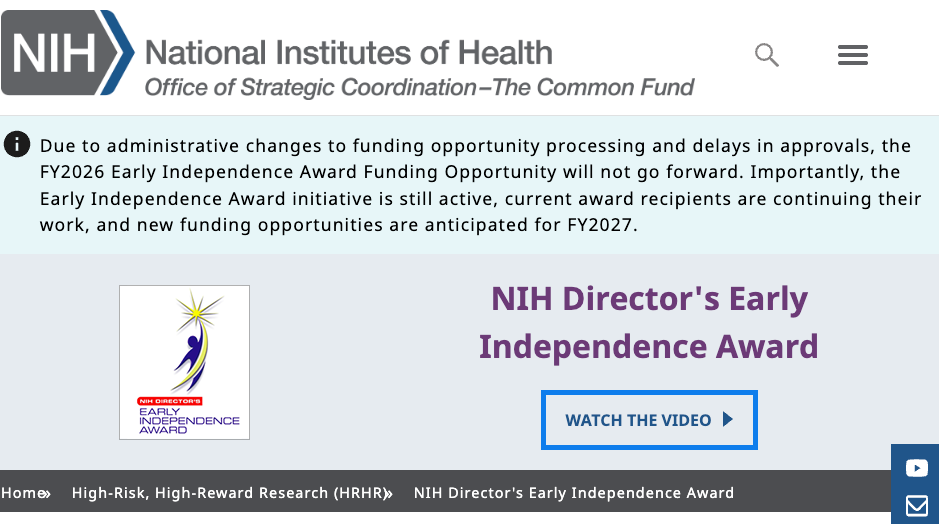
The DP5 was introduced in 2011 and is funded by the NIH Director’s Office through the “High Risk High Reward” program rather than one of the institutes. A DP5 forecast (RFA-RM-26-004) was posted on December 11, 2025, and lists a fiscal year of 2027, an estimated posting date of July 4, 2026, and a project start date of September 30, 2026. As noted in the banner in the below screenshot from the NIH website, the NIH is skipping the FY26 cohort. The forecast expects 10 awards at a ceiling of $350,000 per year, with total FY27 program funding estimated at $5.7 million. This is in line with the past 4 years of spending on the total program.
As you can see in the graph below Michael created, the floor of the program’s historical range is 10 awardees (there are only 3 new awardees YTD, so it is safe to assume that there will be no more since DP5 NOAs are typically issued in September, but we want to give NIH staff the benefit of the doubt because of delays across all programs). Since the DP5 launched in 2011, it has supported 205 investigators, with around 13 new awardees a year peaking at 17 in 2017. The FY27 forecast matches the program’s worst recruitment full fiscal year on record in terms of total scholars supported.
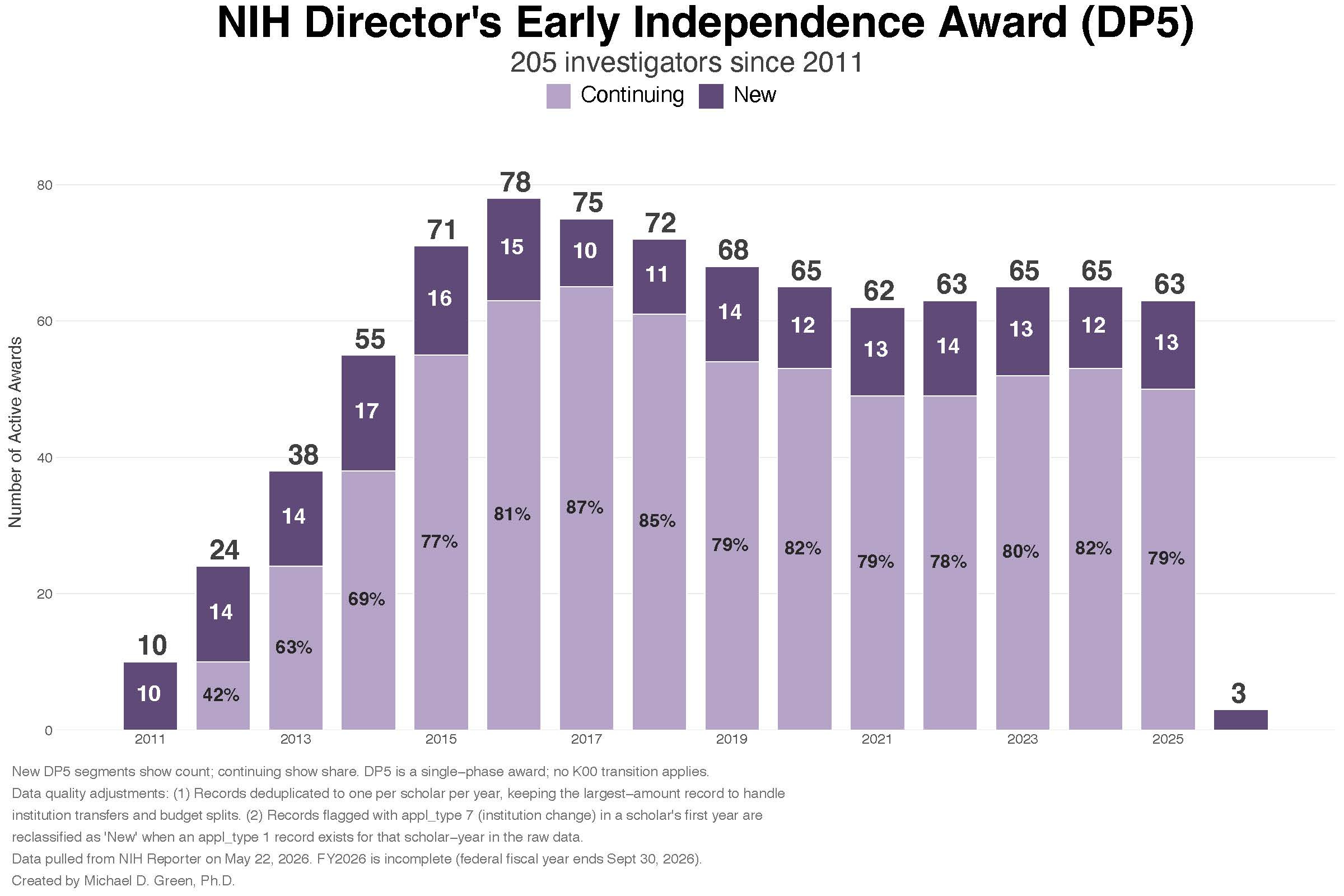
The DP5 forecast is for FY2027 even though it was posted in December 2025. NIH is publicly projecting an opportunity now, telling applicants to prepare for a July 2026 posting, and starting awards on the last day of the fiscal year.
The parent F99 forecast (TEMP-31521) was estimated to be posted on 1/23/2026 and the due date was 4/8/2026. We are about 5 months past when it was supposed to be posted and over a month before the due date. Under this forecast, the estimated award date should be 12/8/2026. Given we are overdue 5 months, should the prospective applicants assume that the estimated award dates are also 5 months overdue? There is a small window when students are eligible to apply for these awards (typically years 3-4 of their Ph.D.) or can even benefit from the support (if they need to resubmit multiple times, they will age out of their window to apply). In normal times, answering these concerns would be the job of a PO like me, guiding the direction of these programs and advising promising investigators. Sadly, these are not normal times.
As Michael noted, I call this the forecast graveyard. But, let me provide some context. In 2025, NIH leadership under the Trump administration mandated a new “forecast” requirement for all NOFOs, a step that had been available since 2017 but was never required for NIH. Mandating forecasts for all NOFOs fundamentally altered how funding solicitations worked. As NIH program staff, we first learned of the specifics of this new requirement in a memo issued on April 1, 2025, from the Office of Policy for Extramural Research (OPERA). The new forecast policy required a minimum of six months from entering a forecast into a new political approval queue before a NOFO could be published. Under the new process, HHS would compile NIH forecast data from grants.gov for the Office of Management and Budget (OMB) to review and identify NOFOs for additional departmental clearance. This is completely unprecedented. Scientific priorities have never been subject to OMB review, and OMB has no statutory authority to override the decision-making processes of NIH institute and center directors and their Advisory Councils.
As this forecast policy has played out over time, the data shows that rather than moving required forecasts into published NOFO status, the NIH has systematically held significant numbers of forecasts in limbo well beyond their promised publication dates. That is what creates the forecast graveyard. A forecasted funding opportunity gets announced in grants.gov, applicants plan around the listed posting date, and then nothing publishes. The forecast sits there for months, or even a year past its expected date with no update and no explanation. From the outside it looks like NIH is functioning because awards are still going out under other mechanisms, but many specific funding mechanisms are quietly being cut off because they are not approved by HHS/OMB. Michael, as an early-career scholar and awardee, has noticed that programs critical for his career stage have clearly been sunset. Maybe they reemerge, but in the interim many young researchers are losing options to support their work.
At a fundamental level this erodes trust in the agency. Applicants can no longer count on planned funding opportunities to actually materialize. This is especially problematic for early career scientists who need to plan well in advance to sustain their career training, and they often have strict deadlines on their institutional financial support. This is why in the past, before the current administration, NIH institutes carefully planned the publication timing of all new training and career mechanism NOFOs to avoid gaps in the solicitation pipeline. The problem we are seeing today with the funding solicitation system has never existed before; it is a product of political interference.
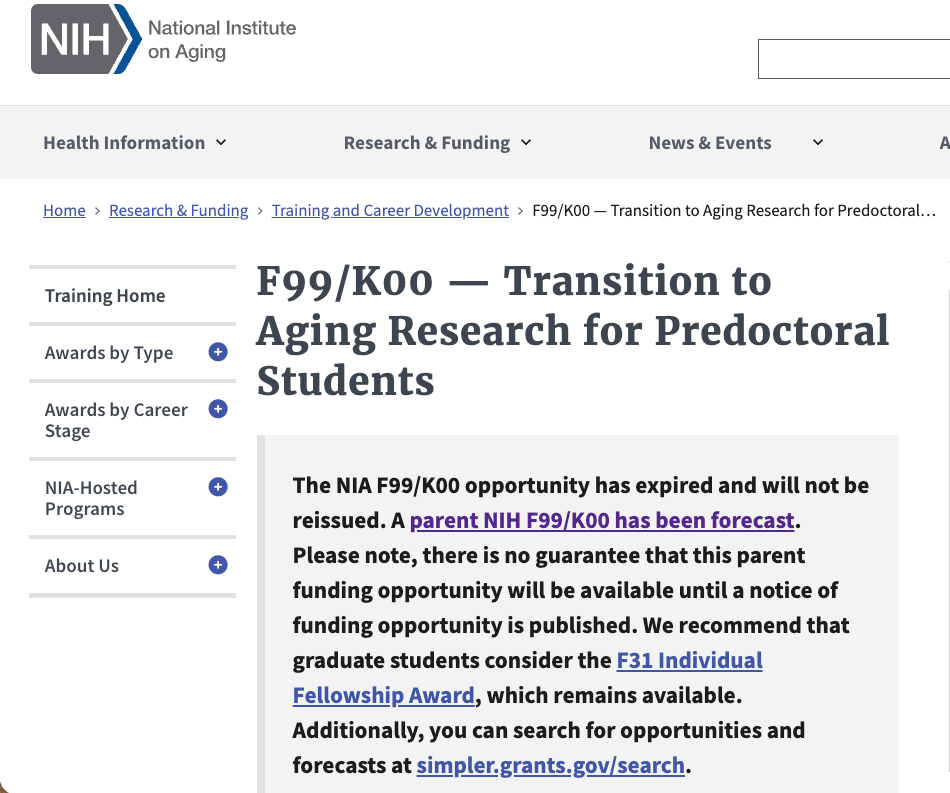
MDG: Elizabeth’s account of the OMB review process explains my data. The NIA website (screenshot below) now recommends that candidates pursue the F31 instead of the F99. This is not an option for the non-citizen students the F99 was uniquely positioned to support. The F99 and DP5 are both programs created to promote innovation in research. Allowing both to lie in the forecast graveyard cuts directly against the stated goal of supporting young scientists. Why throw a wrench in their progress with empty forecasted promises?
Future Problem
MDG: While outlining this essay I asked BlueSky for help framing the argument.
The common themes of the feedback I got were: 1) The most urgent problems at NIH right now are the rate at which funding leaves the agency and the growing opacity of how selection decisions get made. 2) Without money there is no science to run experiments, hire people, and share your work.
I do not expect the former issue to resolve in the short term, since as Liz and I articulated throughout this article, the issue is manmade. Regarding the latter, administrations change and I am already thinking about what the NIH portfolio should look like under different leadership. A plan needs to exist before that window opens. I am planning a follow-up essay that will lay out a proposal to reallocate some of the new-award allotment from the F32 toward the K99, from the F31 toward the F99, and a portion of both toward the DP5. Early simulations suggest it is possible to direct more dollars toward investigators at the earliest, least stable points in their careers without growing the total budget. A growing budget would let us do both. Within current constraints, reallocation is the lever available.
Footnote:
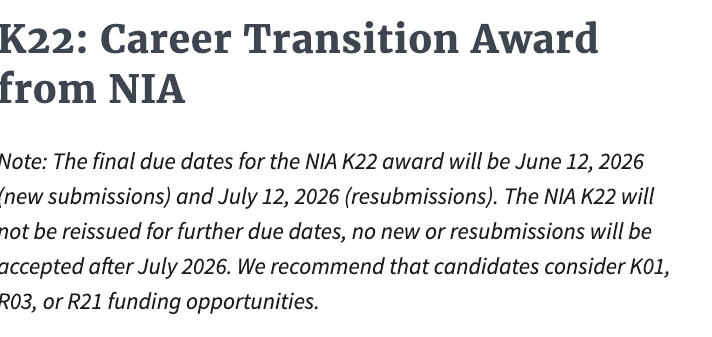
i. I did not include the K22 award in my analysis, it is an award that is meant to be applied to in the post-doctoral years to launch someone’s career (similar to the DP5). The K22 is 3 years of funding and lower yearly direct costs than the DP5. NCI, NIAID, and NHLBI have offered K22s for 20+ years, NINDS, NIDCR, 10+, then NIA for 5+ (now with the opportunity indicating it will not be reissued in the future).
This is super helpful, thank you. Not a good picture.
I'm laser focused on the F31 mechanism and an wondering the extent to which the decreases can be attributed to the discontinuation of the F31D mechanism. I guess you would see this by looking at 2023 and 2024, looking at the number of F31Ds in those years, and subtracting them from the total F31 numbers, and comparing those to 2025. A complication is that some of the canceld F31Ds were reinstated after some lawsuits. But no new F31Ds were issues and not all active F31Ds were reinstated.
When the F31D came along, I wondered why NIH didn't just increase the F31 budget to provide more F31s overall, rather than add more that were earmarked. I mean, I never imagined we would have such a hostile government, but the F31D made it very easy for them to reduce the number of F awards with the stroke of a pen.
On a related note, you don't mention at all here that the overwhelming majority of PhD students are NOT supported by Fs, and in fact are paid as research assistants on RPGs, mostly R01s, and R35s. This doesn't undermine the argument of your article here at all, in fact given the cuts to Rs, this is likely to have an even bigger impact on the early career scientist pipeline. But the decision, or maybe it wasn't so much of a decision as it was a slide, to grow graduate programs via R grants was a phenomenally stupid one and has had all kinds of negative implications for training. Certainly a topic for another post. I was just noting the omission.
Also, what about T32s? What's happening there?