


I was given an opportunity to submit a question for the National Institutes of Health (NIH) Director on the 2/26/26 episode of “Why Should I Trust You?” It made me nervous. I am 26 years old and have not earned a paycheck in two months, even though I hold a prestigious and highly selective NIH fellowship, one designed to provide a smooth transition from a PhD program into a postdoctoral position. Due to disruptions at the NIH over the past year, my experience has been anything but smooth. I got over my fear of retaliation from the NIH because I think it is important to practice courage in moments when courage is required.
My Situation
I was awarded an F99/K00 fellowship from the National Institute on Aging (NIA) in August 2024. This award is one of the most competitive pre-doctoral fellowships the NIH offers across all institutes: both U.S. citizens and non-citizens are eligible to apply. Only 69 individuals have ever received it at NIA. It provides up to six years of funding and is specifically designed to give early-career scientists a runway to pursue new research areas.
My grant focused on studying whether patient-reported discrimination in healthcare settings is associated with cardiovascular and cognitive health outcomes. It was peer-reviewed, scored competitively, and awarded through the standard NIH process.
In July 2025, at my yearly progress report, NIH told me my grant needed to be renegotiated to remove what they called “DEI activities.” They gave me one week to rewrite 70+ pages of work. I asked for specifics on what had been flagged as “DEI-activities”. I received none. So, I removed references explaining why the mistreatment Black adults report in healthcare settings is consequential. I did not change my methods at all, just the proposal framing. The grant was approved for year two of the project in August 2025.
In October 2025, I notified NIH that I wanted to start my postdoc in January 2026. On January 7, 2026, a day after what should have been my start date, I was told the grant needed to be renegotiated again. Based on an analysis I wrote in a previous substack post, of the 69 recipients of this award at NIA, I am the only one who has ever had to change the content of their grant.
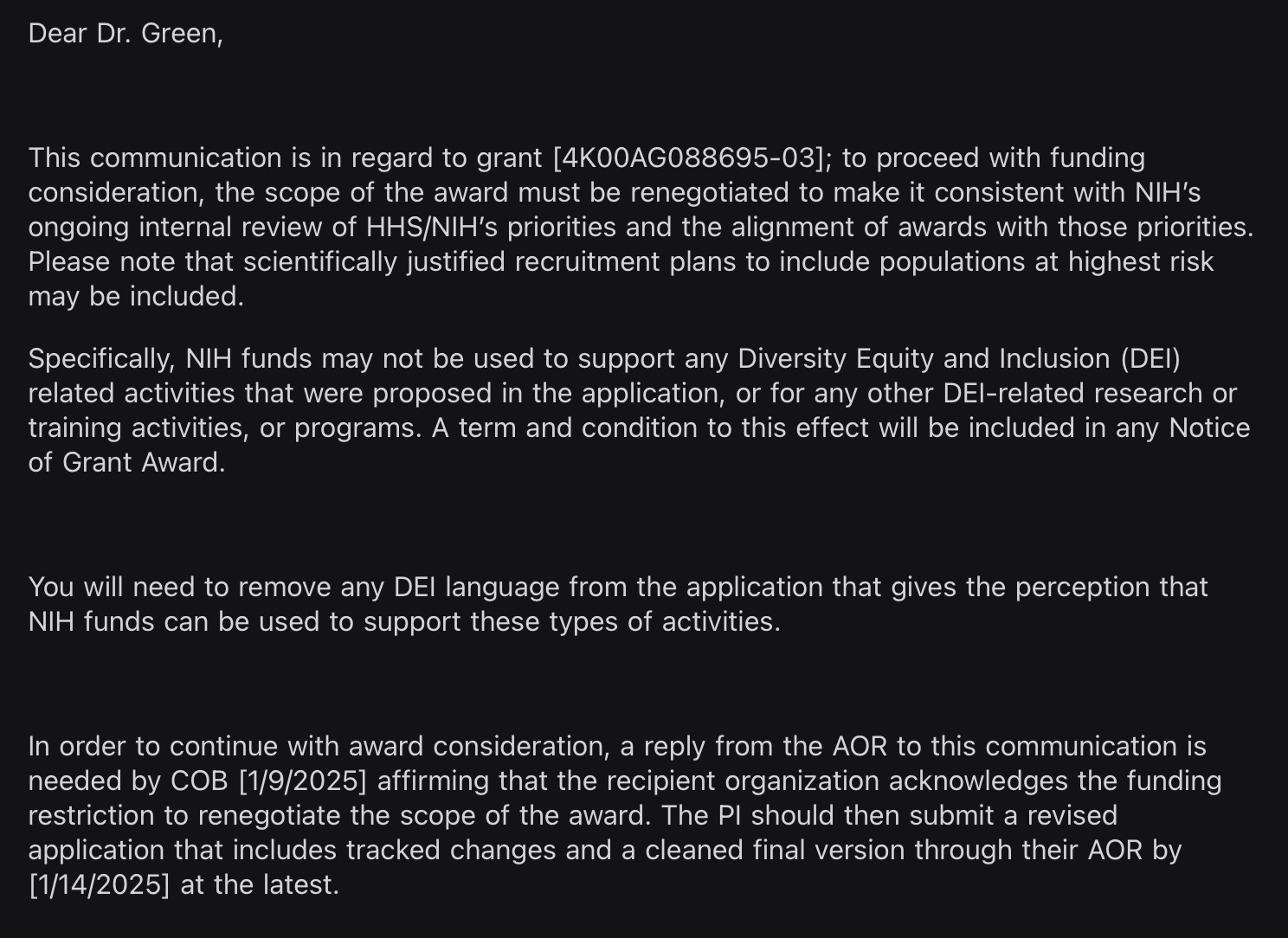
There’s a concurrent issue here – it is complicated to explain but important. Recent reporting has confirmed that NIH funding is being held up even though Congress appropriated a higher level of scientific spending for 2026 compared to 2025. The simplest way I can explain it: Congress wrote the check, the NIH deposited it, but the White House and the Office of Management and Budget placed an indefinite hold on the funds. You cannot pay researchers with money on hold, just like your bank will not let you make a purchase with funds that have not cleared.
Why I Asked My Question
Given how opaque this process has been, I thought the most productive use of this platform was to ask for clarification on what a “DEI activity” is. Twice I was told my research qualified. Twice no one defined the term “DEI activity”. In previous settings, DEI grants were defined as programs where only some people were eligible to receive funding. My award was not one of those; anyone could apply. Instead, I assumed my grant was flagged as “DEI” due to its mention of discrimination, black adults, etc.
At first glance, my grant could appear to be about race because I wrote about Black adults and their experiences in healthcare (justified because of documented disparities in heart disease). But in the application itself, I clearly outlined how I planned to test potential consequences of discrimination across the full sample. The language that I believe sparked the “DEI” censorship were statements about poor treatment of Black adults in healthcare settings, but the scientific design was always inclusive of all groups.
My question came from lived experience and good faith. I did not ask it to embarrass Dr. Bhattacharya. I asked it because I genuinely do not know what a “DEI activity” is. That label and lack of clarity has temporarily cost me my income, my health insurance, and months of my early career.
What I Said
Below is the transcript (sourced from the Why Should I Trust You? page) from my question that was aired on the 2/26/26 episode of the “Why Should I Trust You?” podcast, which was recorded the same day. In the footnote I have attached the uncut clip of my recording that I sent to Brinda (sorry Brinda for yapping so much).
Michael Green 50:10
My name is Michael Green. I recently finished my PhD in Population Health Sciences at Duke University, and I’m a recipient of an F99/K00, award from the National Institute on Aging. That program is designed to support early career scientists with their PhD and into a postdoc. I’m a black man in his late 20s who come from a family where a lot of people stopped going to their doctor for preventative care because they felt like they weren’t being listened to. By the time they came back, it was often too late. My grant focused on studying how patient reported discrimination in healthcare settings is associated with cardiovascular and cognitive health outcomes. It was peer reviewed score competitively and awarded in August of 2024. In July 2025 NIH told me my grant needed to be renegotiated to remove what they called DEI activities. They gave me a week to rewrite 70 pages of work. I asked for specifics on what was flagged, and I received none. So I [re]moved the word black from my grant and references to evidence on why black adults report feeling mistreated in healthcare settings. I didn’t change my scientific approach at all, just the language. I didn’t have a learning moment from the process, because I still don’t know what a DEl activity is.
[In] The context of my grant, no one told me. It’s now late February. I’m unemployed. I have no health insurance. I haven’t received a paycheck since I graduated in December 2025, and out of the 69 recipients of this award at NIA, I’m the only one who has ever had to change the title of their grant beyond punctuation and [spelling]
Brinda Adhikari 51:42
Okay, so Jay, what would you say to Michael Green in that situation?
What He Said, and What He Got Wrong
Jay Bhattacharya 51:47
I’d say that he didn’t take advantage of the opportunity to rethink his grant. Like, we gave him the opportunity, and he didn’t take advantage of it, right? So he again, I didn’t know this grant specifically, but, like, I’ll tell you, like, based on the title, what I hear is a grant where it has as a premise, something that, in principle, couldn’t have a control group.
And so its bad science….
Brinda Adhikari 52:09
So what would have made us better?
Jay Bhattacharya 52:11
Just okay for let me just finish Brinda. So I think if, if I say that, I provisionally, because, again, I’ve not read his grant so, but based on that 90 second snippet, he had the opportunity to be more specific about his hypotheses, make them actually scientific, give them give make arguments for control groups. We gave him that opportunity, and he didn’t take it. That’s what I’d say.
What the NIH Director missed: Around 80% of the people in my study sample reported never experiencing discrimination in healthcare. That is the comparison group. That is the control. The study examines differences in health outcomes between those who reported discrimination and those who did not. This is a straightforward, well-established epidemiological design and a reasonable one for a PhD dissertation project. The methods I used were novel for exploring the consequences of discrimination experienced in healthcare, which I believe is part of the reason why the grant was scored competitively and was awarded.
The Deeper Contradiction
After this statement, Brinda asked a direct question:
Brinda Adhikari 52:35
Let me ask you, you know, is it worthwhile? Because I know that one of the things you have talked a lot about is improving health outcomes. Do you believe that there is scientific merit to studying the role that discrimination plays in health outcomes?
Jay Bhattacharya 52:56
What do you mean by discrimination?
In an interview with Ross Douthat from New York Times Opinion on January 29, 2026, Dr. Bhattacharya said that free speech is a moral and ethical imperative for science. On February 26, 2026, he evaluated my funded, peer-reviewed grant he had never read and called it “bad science” based on its title. He used this to justify forcing me to rewrite my work. His support of free speech and his rejection of my scientific aims cannot coexist.
Every NIH Director has the right to set new scientific priorities. But if the label “DEI activity” can be applied retroactively to funded, peer-reviewed research without a clear definition, then any label can. Three or four years from now, a new NIH Director could decide that grants classified as “MAHA activities” need to be renegotiated. The precedent is the same. The process, or the erosion of it, is what should concern everyone regardless of where they sit on the political spectrum.
Dr. Bhattacharya claims to want to encourage innovative ideas from a new coalition of researchers. Many of my peers who are interested in his stated priorities have reached out to me, not to disagree with his version of science, but to tell me they have little faith in his leadership and claimed support for early-career scientists. I am still waiting for an answer to my original question and also have 3 clarifying questions that everyone deserves an answer to.
1. What is the definition of a “DEI activity,” and how is it being communicated to NIH staff so they can determine whether a grant qualifies?
2. What would your reaction be if a future NIH Director decided to force all grants considered “MAHA activities” to be renegotiated three to four years from now?
3. How does the current instability at the NIH positively impact the careers of early-career researchers?
Footnotes:
Link to the unedited clip I sent to the podcast.
The probably won't ever define "DEI" because then a court could slap it down as clearly illegal. Instead, Jay B will bob and weave. My best guess is that this administration doesn't want to fund any research examining discrimination of any kind. Remember the MAGA movement is built on white grievance. Denying systemic racism or discrimination is a core part of the "anti-woke" platform, which is a major, unifying force for the MAGA base. This strategy is designed to appeal to, rather than suppress, racial grievances and resentment. Jay B has to go along. He has no choice but to toe the line. Meanwhile, promising scholars like you will be the victims of this nonsense. Tragic indeed.
Thanks for writing this important essay.