


Disclaimer: As always, the views I share in this post are my own. They do not necessarily represent the views of my employer or research sponsors.
I am awaiting a notice after the renegotiation of my K00 award. If the NIH approves my K00 Transition plan and I successfully start a post-doctoral research position, I will write another blog and link it here. I submitted a comprehensive proposal that outlined my post-doctoral plan in early October 2025 (notably in the middle of the 1st government shutdown). I requested a January 1st, 2026 start date, and in the middle of January 2026 I received a request to renegotiate the scope of the proposal.
I have academic freedom, and NIH data is publicly available, so I decided to ask the question: what has the history of the National Institute on Aging (NIA) F99/K00 award been to date? Currently, NIH staff are producing less public communications, and I believe that as a scientist, understanding how NIH programs function matters since many of our careers are attached to that infrastructure. Selfishly, my own experience drove this as well. I suspected within the extramural grant portfolio of the National Institute on Aging; my award was the only F99/K00 they had asked to renegotiate. Singularity is incredibly rare in research, so instead of feeding my own delusion about my status, I decided to dive into the data (spoiler: based on my analysis I am correct).
My methods are described below:
Dr. Jeremy Berg, posted a tutorial on analyzing NIH grant data, which is publicly available. The NIH introduced the F99/K00 program at National Cancer Institute, and a few other institutes have since adopted it. The National Institute on Aging (NIA) introduced the program in 2019 and issued the first awards in 2020. I queried NIH Reporter data and imported it into RStudio. I found 69 unique individuals with the F99/K00 award from NIA. Below you can see the breakdown of the awards by NIH fiscal year. For those unfamiliar with NIH grants, the NIH issues awards as “new awards” in year one. That indicates someone who applied for the grant received it. The NIH also issues continuations, which traditionally means another year of funding for that grant. There are a bunch of other categories for continuations, but for this program, the options are limited. In the grant proposal, you outline your multi-year plan. Annually you communicate your progress to NIH staff, and your award is renewed/continued. For “transition” or “boomerang” awards (e.g. the F99/K00 or the more common K99/R00), you have the added benefit of another award at a different career stage. Below, I indicated the “new” awards in dark blue and the first year of the second phase of the award in dark orange.
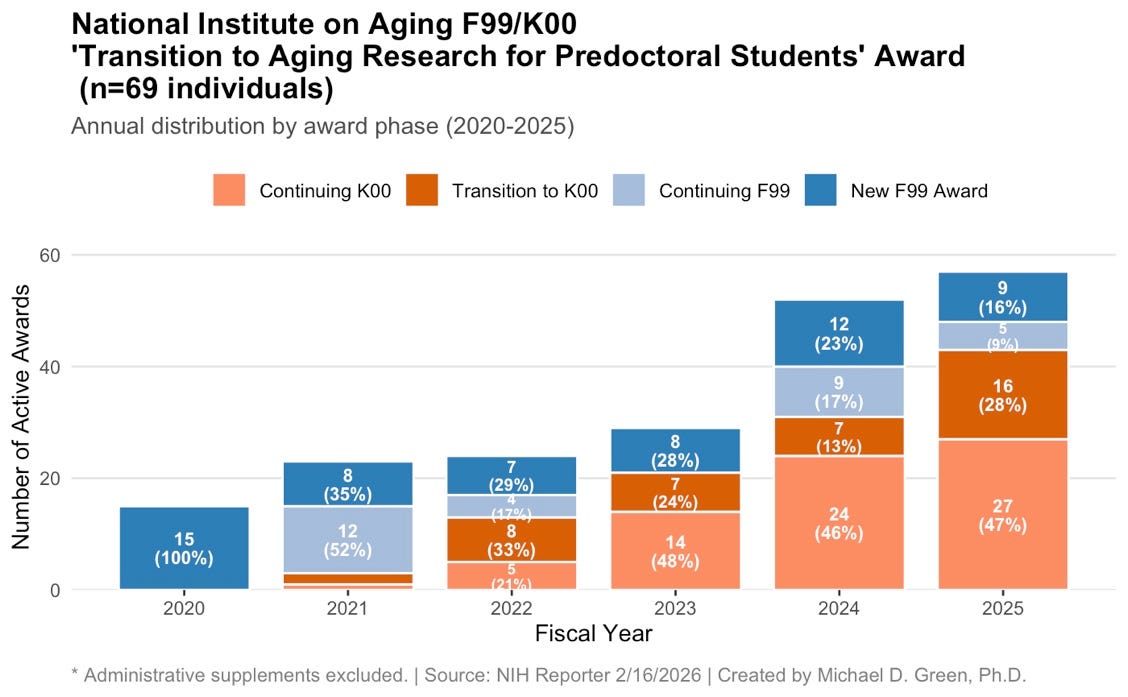
For the pre-doctoral fellowship award (F99), you get 1-2 years of support and during that period, you request the second phase (K00) of the award. The post-doctoral phase is 3-4 years. You get the 4th year of funding if you apply for a career development (K01, K22, K99) award. A career development award in theory would support your transition to a faculty position if awarded.
In many ways, this program supports an individual researcher. It also thoughtfully provides a pathway to a faculty position. This pathway is in touch with the present-day reality in which biomedical researchers are hired both on their research productivity and grant-writing ability. A common talking point of current NIH leadership is that they want to support individuals. In fact, the NIH Director came to my Ph.D. institution for a Zoom fireside chat in January (the first of a series to celebrate 30 years of the Duke Clinical Research Institute). I watched it in its entirety, and he mentioned that he would like to focus on supporting early career researchers. He claimed that he wanted to redo the entire K award process because he felt that it was not currently suited to support early career people. I agree; currently, most institutions are on soft-hiring freezes and can only bring in faculty who have their own funding. Revamping the K-award process would, in theory, change this prospect. The source of the soft-hiring freeze at schools of medicine and public health nationally is largely because of the changes and threats of change at the NIH the past year. So, how much money is coming in and how the NIH administers awards has changed, but the incentive structure where universities depend on their researchers bringing in grant money has remained intact.
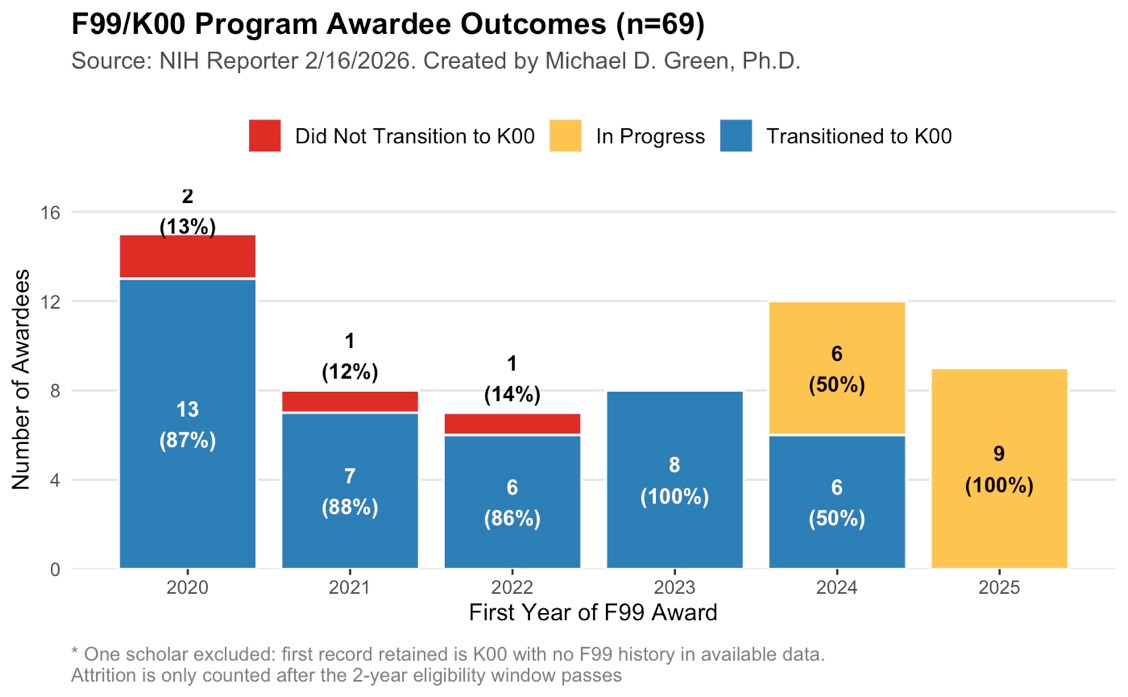
Back to the F99/K00 program, a program centered on individuals. The whole purpose is to provide a pathway for doctoral students to have their dissertation work and post-doctoral training paid for. In simpler times, a student would be in high demand with this award for a post-doctoral position because they are bringing money for their salary and career development funds. This candidate would even be in a position to negotiate for more compensation. Given the contraction of university (and in turn faculty) budgets, this is a less reasonable ask. It is still a way better situation than those without a grant. Below, I pulled together a graph looking at the outcomes of the NIA F99/K00 awardees. Each year is the total number of new awards. The first three years (2020-2023), only 4 out of 30 did not advance to the K00 phase. I did some LinkedIn sleuthing, and those individuals appeared to have started a tenure track job or a job outside of academia. I would classify those outcomes as successful under the described goal of the F99/K00 award. Since 2023, there has been no other attrition, but there are 15 individuals whom we still do not have data for since they are not outside of the 2-year window from their award start date in 2024.
My hypothesis was that some of the awardees had to deal with renegotiating their award. I thought the simplest way to test this was seeing if any of the awardees had to change the title of their grant to remain compliant with “anti-DEI” initiatives from the NIH. Across all 69 individuals, I found 4 awards that had changed their titles mid-phase. 2 of them were changes in spelling/punctuation, 1 was indicating an extension of the award, and the final one seemed to be a meaningful change in the scope of that award (another spoiler: that last one is me).
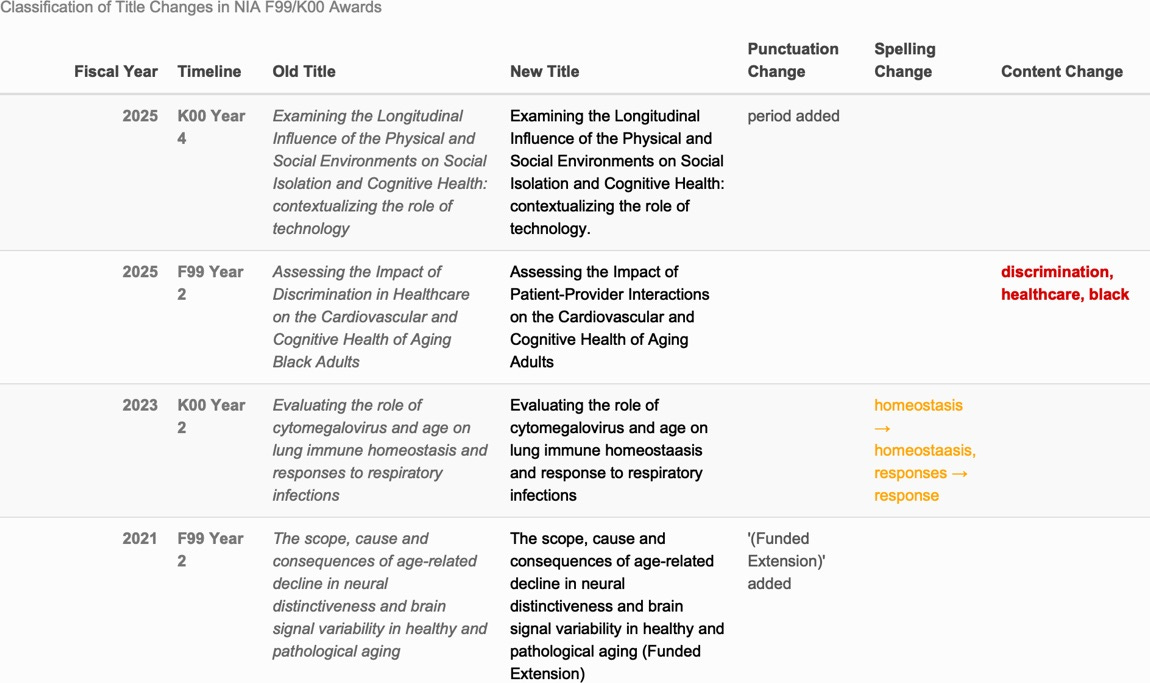
Some might consider the F99/K00 program a success because the early career researchers who have gone through this program are both making it to the next career stage and are also relatively unscathed from political backlash against “health equity” topics (e.g. no awards have been terminated). This is a fair assertion for now.
My new question is: why make scientific reviewers, NIH staff, and many more review these grants and move the goalposts of what is a worthy award midstream? As an early career researcher, I love the idea of supporting individuals. From my view the F99/K00 award, which is an investment in individuals, is a great opportunity to learn from existing programs. Reviewing the NIH extramural grant portfolio, reviewing the and outcomes of researchers, and investing in the awards that allow people to advance their careers makes sense but is not happening. Treating staff well and humility about the tools at your disposal would also go a long way. Talk does not mean much to people who have the ground shake beneath them every day. All early career researchers feel the ground shaking beneath them, but are being told that people care about their work and their future. The ramifications of program instability might be affecting the “health equity” researchers most acutely, but all universities are feeling the contraction. Even worse, a new administration could easily unravel any researcher’s proposed ideas that are aligned with the “new administrative priorities” just as cruelly as the health equity work was unraveled.
Investing in individuals is a great idea, for me that has so far meant missing a January paycheck and possibly missing a February paycheck. I do not have children or others depending on me so I have been able to manage that, it for sure is less than ideal coming out of earning the institutional minimum Ph.D. stipend for 4.5 years. If we want to think about supporting new ideas, this is another bottleneck which is widely out of touch with bringing more researchers from different backgrounds and perspectives into our figurative tent.
We need to strive for better. The tools are at our disposal to do so. At NIA, the F99/K00 program is currently expired. The only NIH institute that is actively accepting F99 applications is National Institute of Child Health and Human Development (NICHD) and it is only for projects focused on Down Syndrome Research. An investment in early career researchers would involve expanding programs like the F99/K00 to all institutes and cutting red tape for people at the beginning of their careers. Neither happened.
Two important points:
1. Since this is an individual-centered award, a critique of the award is a direct critique of me. I am curious what about my background and interests do not have “merit”?
2. If you’d like to review the data, it is fairly simple to query, but I linked it here in “long” format without investigator names.
https://drive.google.com/file/d/1YnPhpD76x87yvrBzx5fXk7jEocDXcOOX/view?usp=sharing
Impressive sleuthing that leverages government accountability to connect the macro of politicizing science to the micro impact of it on your own research. And although it’s outside my domain, I look forward to these posts for inspiration as ways to fit finding a place for liberal research in my career thinking and how to write about it. Keep it up my friend.